HAL interface for PWM (Pulse Width Modulation) configuration and control. More...
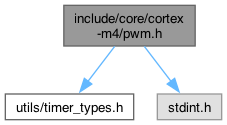
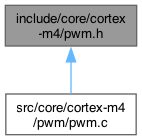
Go to the source code of this file.
Classes | |
| struct | PWM_Handle |
| PWM handle structure linking timer and channel. More... | |
Functions | |
| void | hal_pwm_init (PWM_Handle *pwm, uint32_t frequency, float dutyCycle) |
| Initialize a PWM handle with the specified frequency and duty cycle. | |
| void | hal_pwm_start (PWM_Handle *pwm) |
| Start PWM signal generation. | |
| void | hal_pwm_stop (PWM_Handle *pwm) |
| Stop PWM signal generation. | |
| void | hal_pwm_set_duty_cycle (PWM_Handle *pwm, float dutyCycle) |
| Set the PWM duty cycle. | |
| void | hal_pwm_set_frequency (PWM_Handle *pwm, uint32_t frequency) |
| Set the PWM frequency. | |
Detailed Description
HAL interface for PWM (Pulse Width Modulation) configuration and control.
This header provides:
- PWM handle structure linking hardware timers and channels.
- Functions to initialize, start, stop, and configure PWM signals.
- Copyright
- © NAVROBOTEC PVT. LTD.
Function Documentation
◆ hal_pwm_init()
| void hal_pwm_init | ( | PWM_Handle * | pwm, |
| uint32_t | frequency, | ||
| float | dutyCycle ) |
Initialize a PWM handle with the specified frequency and duty cycle.
- Parameters
-
pwm Pointer to the PWM handle. frequency PWM frequency in Hz. dutyCycle Duty cycle as a percentage (0.0 to 100.0).
Initialize a PWM handle with the specified frequency and duty cycle.
- Parameters
-
[in,out] pwm Pointer to PWM handle structure [in] frequency Desired PWM frequency in Hz [in] dutyCycle Initial duty cycle (0.0 to 1.0)
Configures the timer peripheral to generate PWM signals by:
- Selecting the appropriate bus clock (APB1/APB2)
- Calculating prescaler and auto-reload values
- Setting the initial compare value for duty cycle
- Initializing the timer peripheral
- Note
- For advanced timers (TIM1, TIM9-TIM11), APB2 clock is used automatically
◆ hal_pwm_set_duty_cycle()
| void hal_pwm_set_duty_cycle | ( | PWM_Handle * | pwm, |
| float | dutyCycle ) |
Set the PWM duty cycle.
- Parameters
-
pwm Pointer to the PWM handle. dutyCycle Duty cycle as a percentage (0.0 to 100.0).
Set the PWM duty cycle.
- Parameters
-
[in,out] pwm Pointer to PWM handle structure [in] dutyCycle New duty cycle (0.0 to 1.0)
Updates the capture/compare register to change the PWM duty cycle while maintaining the current frequency. The change takes effect immediately on the output.
- Note
- Duty cycle is clamped to valid range (0.0-1.0)
◆ hal_pwm_set_frequency()
| void hal_pwm_set_frequency | ( | PWM_Handle * | pwm, |
| uint32_t | frequency ) |
Set the PWM frequency.
- Parameters
-
pwm Pointer to the PWM handle. frequency PWM frequency in Hz.
Set the PWM frequency.
- Parameters
-
[in,out] pwm Pointer to PWM handle structure [in] frequency Desired PWM frequency in Hz
- Note
- This function is currently not implemented
- Todo
- Implement frequency change functionality
◆ hal_pwm_start()
| void hal_pwm_start | ( | PWM_Handle * | pwm | ) |
Start PWM signal generation.
- Parameters
-
pwm Pointer to the PWM handle.
Start PWM signal generation.
- Parameters
-
[in] pwm Pointer to initialized PWM handle structure
Enables the timer counter to start generating PWM signals on the configured channel. The output will appear on the corresponding GPIO pin.
◆ hal_pwm_stop()
| void hal_pwm_stop | ( | PWM_Handle * | pwm | ) |
Stop PWM signal generation.
- Parameters
-
pwm Pointer to the PWM handle.
Stop PWM signal generation.
- Parameters
-
[in] pwm Pointer to PWM handle structure
Disables the timer channel output and stops the timer counter. The PWM output pin will return to its idle state.